The closest approximations we have to true artificial intelligence and hard-light holograms are constant casualties of misunderstood technology. It’s why when I see the two combined, I can’t help but breathe a deep sigh of consternation. Then I have to listen to the incessant prattling of a digital avatar inside a jar, and my exasperation turns to pure annoyance.
Anyway, MSI came to Computex with a desktop PC, the MEG Vision X2 AI, built with a massive glass cylinder in front. Inside the container sat the Taiwanese gaming company’s cute dragon mascot, Lucky. The hologram display uses mirrors and projectors to create the sense of a 3D image. You need to stand directly in front of it to make the character seem 3D.
In other words, this isn’t a hologram you can manipulate with your own hands; it’s a lighting trick. Remember Razer’s Project Ava, aka the “AI waifu?” It was essentially basic holographic technology attached to AI, creating a conversational, desk-side assistant. It was long-winded and not very helpful back at CES 2026, but the concept seems to be sticking within the gaming peripheral community.
I sat there, listening to MSI’s hologram talk my ear off for more than two minutes, after it received the prompt “introduce yourself.” The AI took nearly 10 seconds to respond, then went on a tirade. “Hey, I’m LuckyClaw, MSI’s official AI assistant, here to help you…” Its voice had a tone somewhere between that of the 1990s Sonic the Hedgehog cartoon’s Sonic and a carnival barker. It went on and on about MSI’s promoting “40 years of innovation,” how it was “built for natural conversation,” and so forth.
LuckyClaw is MSI’s AI agent. Essentially, agents use multiple AI models in concert to complete multi-step, complex tasks on your behalf. In an ideal scenario, LuckyClaw would have access to your PC’s data, folders, files, and photos and then use that information to bring up your personal information. For this presentation, MSI trained Lucky on the company’s product lineup for Computex 2026, so it could answer questions about its Claw 8 EX AI+ or new gaming laptops and PC components. The problem is how well it can accurately regurgitate that data without boring you with endless soliloquies.
The long-windedness is a constant issue with conversational AI. It’s not trying to be helpful; it’s just trying to sound human. While MSI only showed off the AI’s conversational skills, the fact that it’s named for the OpenClaw suggests that it can do more on your PC. Maybe it could change Windows or BIOS settings on command. I doubt most will miss needing to trawl through endless Windows just to troubleshoot basic issues.
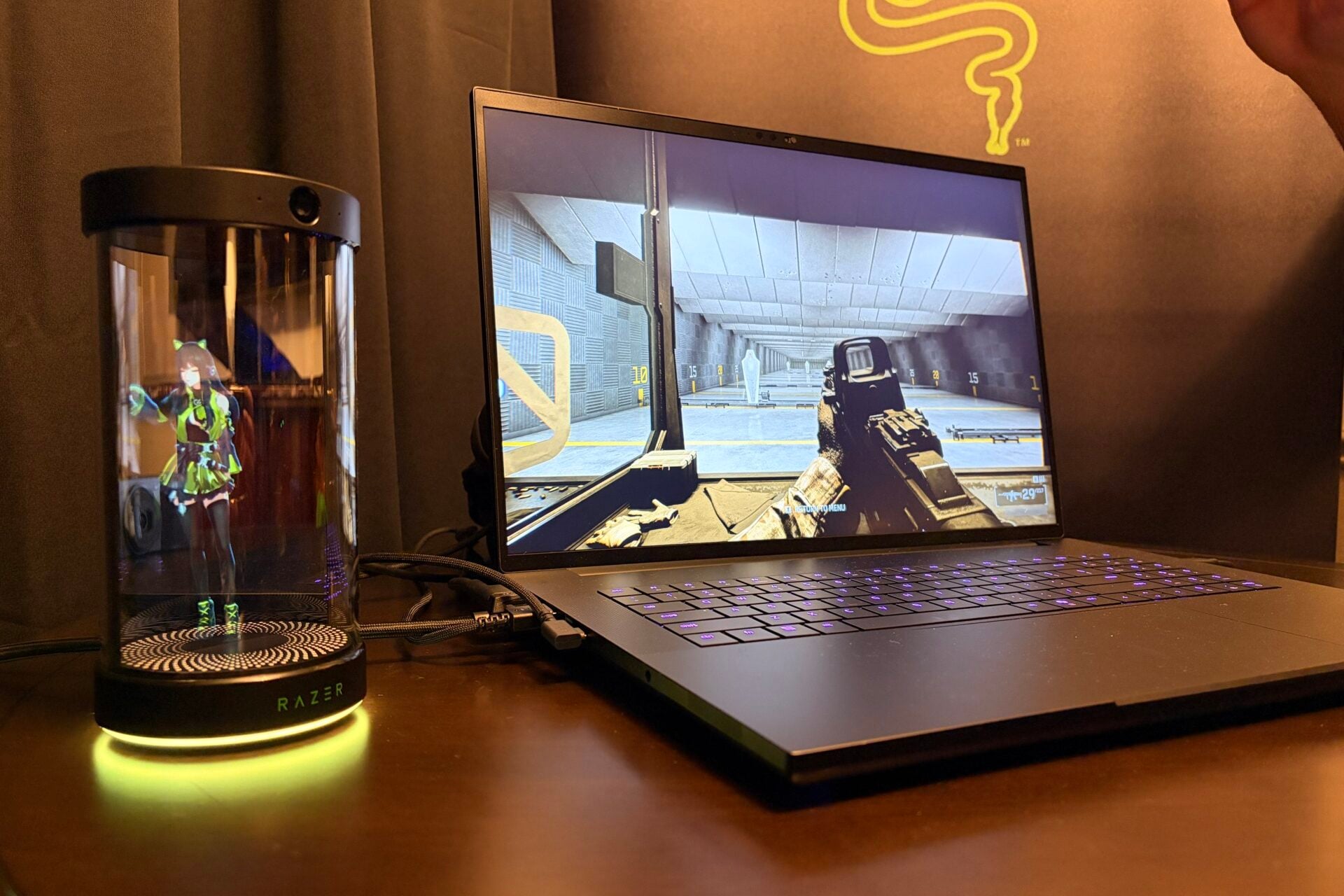
Under ideal circumstances, this AI wouldn’t require an internet connection and could instead run off the PC’s powerful GPU you paid top dollar for. In this case, MSI ran the LuckyClaw model in the cloud—hence the delayed responses. MSI’s MEG Vision X2 should come with either an Nvidia GeForce RTX 5080 or 5090 graphics card, which ostensibly should be capable of running some moderate AI models.
The company behind the MEG Vision X2 told me you should be able to swap the hologram’s avatar with one of your own. However, you can’t upload a simple .jpg of your favorite anime character to talk to, so it’s unclear what kinds of files you’d actually need to be able to do this.
MSI’s hologram-filled PC isn’t just a concept device. The company plans to sell it as a product you can buy, though it hasn’t shared pricing or expected shipping dates. I can only assume, however, that a hologram face on a large language model will likely cost you a premium on top of the cost of an existing, expensive PC.