TL;DR
- Opus Launch: Anthropic has announced Claude Opus 5 as a lower-cost near-Fable option.
- Token Pricing: The company says Opus 5 keeps $5 input and $25 output token rates.
- Benchmark Caveat: Company-cited tests put Opus 5 near Fable, but production workloads still need validation.
- Customer Test: Enterprise customers must verify token savings, safety routing and accuracy before replacing Fable workflows.
Anthropic has launched Claude Opus 5 as its newest Opus-tier Claude model, positioned close to the higher-priced Claude Fable 5 tier for coding and knowledge-work tasks at lower cost. For enterprise customers, the launch offers a stronger Opus option without making Fable the default choice for every advanced workflow.
As enterprise AI spending now faces tighter scrutiny, Claude Opus 5 keeps Opus 4.8 API rates of $5 per million input tokens and $25 per million output tokens. Tokens are the text chunks models process and bill against. Enterprise AI customers are less inclined to experiment without a clear return on investment, so per-task cost now matters almost as much as a top benchmark ranking.
Benchmarks Put Price at the Center
For benchmark context, Claude Opus 5’s company-cited results support the near-Fable pitch, but they are not independent production tests. Frontier-Bench v0.1 measures high-end coding and knowledge-work tasks.
Anthropic said Claude Opus 5 scored 43.3% on that benchmark, compared with 18.7% for Opus 4.8 and 33.7% for Fable 5. The result is useful for comparison, not a guarantee of customer workload performance.
For coding and computer-use tasks, the same price argument gets sharper. Opus 5 reached within 0.5 percent of Fable 5’s peak CursorBench 3.2 score at maximum effort, with Anthropic putting the comparison at half the cost per task.
OSWorld 2.0, a computer-use benchmark, adds a second cost angle because Opus 5 exceeded Fable 5’s result at slightly more than one third of the cost.
Niko Grupen, Harvey’s head of applied research, says the legal AI company saw similar quality from Opus 5 at lower reasoning levels while the model generated 26% fewer tokens on average than Opus 4.8 at maximum reasoning. The customer signal supports the task-cost argument, but it remains one assessment in launch materials rather than a broad market benchmark.
Access, Safety Routing and Developer Workflow
Existing Opus users get the first access point. Claude Opus 5 is available to all user tiers that previously had Opus 4.8, and Anthropic positions it as the default model on Claude Max and the strongest model on Claude Pro, two paid Claude plans. Recent Fable 5 paid-plan access keeps that placement relevant after its free promotional period ended.
For developers, workflow changes may matter as much as the model label. Developers can swap external tools during a Claude conversation without invalidating prompt-cache savings. A prompt cache reuses previous prompt context to reduce repeated processing costs, and Claude prompt caching has been part of Anthropic’s developer cost story since 2024.
Safety routing creates another operational difference from Fable. Opus 5 is not subject to the 30-day data retention policy tied to higher-tier models, reducing one storage concern for organizations wary of longer prompt retention.
Automatic Fallbacks can route an application programming interface request to a less powerful model when a safety classifier blocks a prompt, producing a functional response instead of an error. Anthropic expects safety classifiers to engage 85% less often for Opus 5 than for Fable 5.
Fable Context and Competitive Market
Fable 5 remains the comparator because it sits above Opus in Anthropic’s model ladder and carries higher rates of $10 per million input tokens and $50 per million output tokens. Recent Fable 5 paid-plan placement keeps pricing and availability relevant, but the Opus 5 launch turns on price, plan reach and task performance.
Fable’s regulatory history is a separate caveat: Fable and Mythos were taken offline after U.S. government concern before an export-control lift restored Fable availability with guardrails.
Competitive pressure keeps the cost question open, as Moonshot AI’s Kimi K3 model gives customers another lower-cost model to test. Anthropic now has to show that Opus 5’s lower per-token price, selected benchmark gains and workflow mechanics produce dependable everyday value, not just a cleaner slot between Opus 4.8 and Fable.
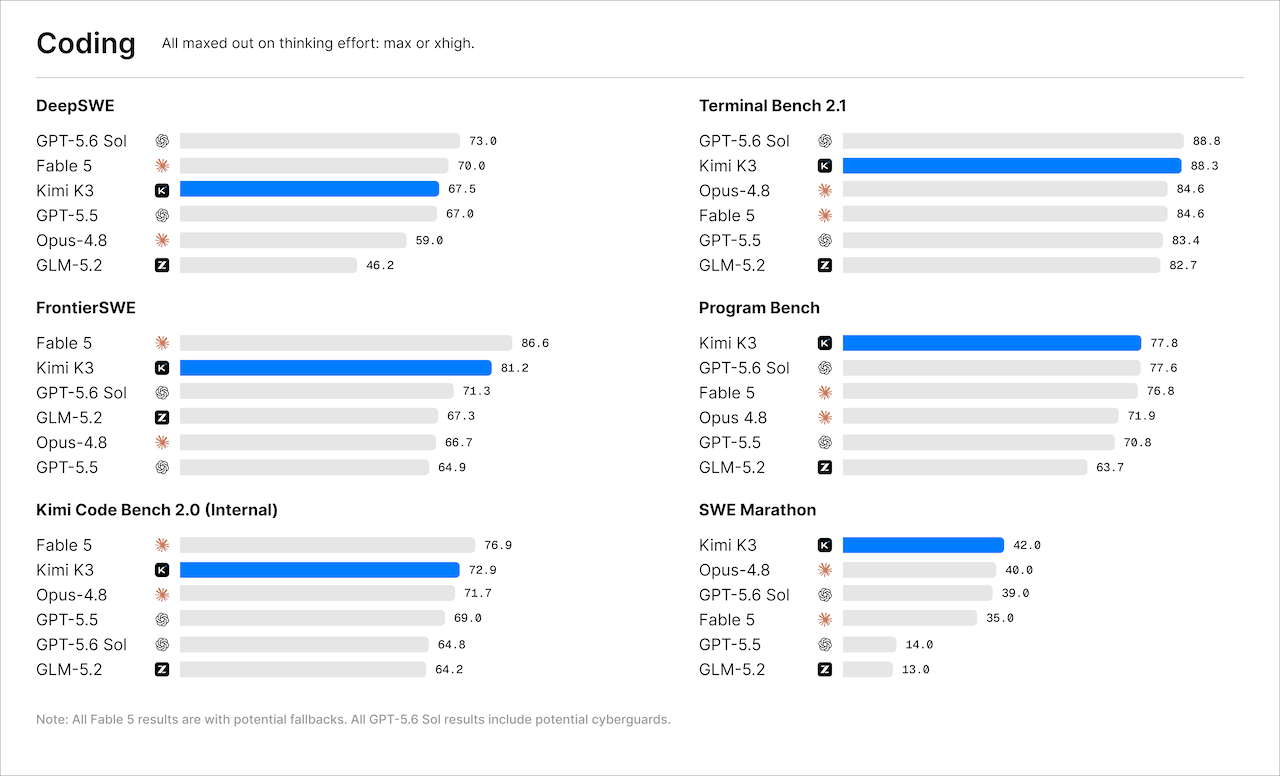
Enterprise customers’ first production gate is concrete: reproduce Harvey’s finding that Opus 5 uses 26% fewer tokens on average without raising Opus 5’s accuracy risk over Opus 4.8.